Hanoi University of Science and Technology (HUST)https://www.hust.edu.vn/uploads/sys/logo-website02_136_200_1.png
Tuesday - 03/03/2026 23:27
In the near future, stepping onto the campus of Hanoi University of Science and Technology (HUST) will offer a truly international experience. Visitors will be greeted by comprehensive bilingual signage and directories, in line with our strategy to progressively transition towards an English-only environment.
In the context of the rapid pace of global integration and digital transformation, language barriers have emerged as one of the major 'bottlenecks' facing the young workforce. Recognizing this critical challenge, Hanoi University of Science and Technology (HUST) is progressively realizing its strategic goal of advancing English as the second language throughout the university, thereby elevating the capacity and quality of teaching and learning this global language.
Speaking to the HUST Website, Assoc. Prof. Nguyen Xuan Quyen, Deputy Head of the Department of Academic Affairs, noted that English language education has been a focus at HUST since 1975. However, we just have witnessed a truly remarkable transformation recently.
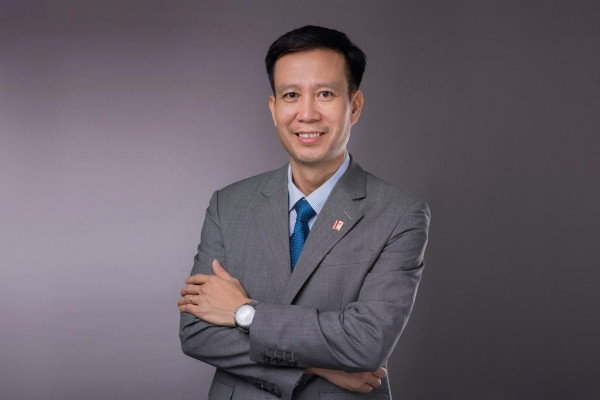
Assoc. Prof. Nguyen Xuan Quyen - Deputy Head of the Academic Affairs Office, Hanoi University of Science and Technology.
Figures signaling positive trends
*From an academic management perspective, could you elaborate on the current situation of English teaching and learning at HUST?
- In alignment with the rapid advancements in science, technology, and digital transformation, 100% of fundamental English courses at HUST have been delivered via digital platforms since 2022. Students now benefit not only from direct interaction with their instructors but also from the comprehensive support of modern digital learning resources and online tools. Concurrently, our Centre for Foreign Language Assessment and Culture Exchange organizes international TOEIC and VSTEP examinations, thereby establishing a versatile assessment framework tailored to diverse groups of learners.
Furthermore, the admission results from the recent cohorts have shown a highly positive trend: the proportion of incoming students holding international foreign language certificates has steadily increased from 16.8% (Cohort 67) to 24.6% (Cohort 68), reaching 33.7% (Cohort 69), and impressively climbing to 44% (Cohort 70).
Not only has the quantity increased, but the quality of IELTS scores has also improved significantly. While the majority of students in Cohort 67 achieved scores between 5.5 and 6.5, Cohort 70 has witnessed a sharp rise in the 6.5–7.0 bracket, accompanied by a marked decline in scores below 5.0. Notably, the rapid growth in the number of students achieving 7.5 or higher strongly reflects an increasingly globally integrated incoming student body.
This advantage enables numerous students to gain exemption from foundational English courses and seamlessly transition into fully English-taught programs.
Since 2007, HUST has developed the ELITECH programs, which are high-quality bachelor's and engineering degrees delivered entirely via English-Medium Instruction (EMI). To date, the University has successfully established 16 ELITECH programs, with a strategic vision to expand to 18 programs by 2026.
At HUST, students are immersed in diverse, premium academic environments and mentored by distinguished, highly experienced faculty. These dedicated educators deliver complex subjects ranging from Mathematics and Physics to specialized core courses entirely in English. After nearly two decades of implementation, our teaching staff has masterfully adapted to and excelled within this innovative model.
Determines to make English the second language across the entire university
*On October 27, 2025, the Prime Minister approved the project titled “Making English a Second Language in Schools for the Period 2025-2035, with a Vision to 2045.” Following the Government’s direction, the Ministry of Education and Training has been taking decisive actions to promote English education in schools. In line with this national initiative, what concrete steps has Hanoi University of Science and Technology taken, Sir?
- In order to effectively implement this directive, Hanoi University of Science and Technology has developed the project “Making English as a Second Language at Hanoi University of Science and Technology for the Period 2025-2035, with a Vision to 2045.” The project includes clear objectives, a specific roadmap, and detailed task allocation, and it will be implemented starting from early 2026.
During the process of developing the project, the relevant units within Hanoi University of Science and Technology worked together to analyze and evaluate key aspects of the plan. In particular, the university has identified both the advantages and challenges involved in implementing the project.
* What advantages and challenges has Hanoi University of Science and Technology identified in implementing the university’s own project?
- The university frankly acknowledges that students’ English proficiency levels still vary considerably. This creates difficulties for lecturers when designing lessons. Therefore, the new project at Hanoi University of Science and Technology proposes an appropriate roadmap that provides targeted support for students who need to strengthen their foundations, ensuring that no student is left behind.
Hanoi University of Science and Technology also hopes to lay the foundation for a peer mentoring model, in which high-achieving students act as mentors to support classmates who face greater challenges. This “progress peers” approach not only improves learning quality but also fosters a more connected student community, creating memorable experiences within the HUST community.
In the era of digitalization and the rapid growth of AI, students now have access to a wide range of self-learning tools. In addition to the digital platforms provided by Hanoi University of Science and Technology, learners can actively explore international applications and resources to further develop their language skills and overall proficiency.
*Could you share the immediate goals of this project? In 2026, what should the staff, lecturers, and students of Hanoi University of Science and Technology focus on?
- In 2026, Hanoi University of Science and Technology will strengthen the recruitment and invitation of international lecturers to teach courses in advanced programs across all semesters. At the same time, BKConnect - the Bach Khoa Connection Portal will be further developed to support international student and faculty exchanges.
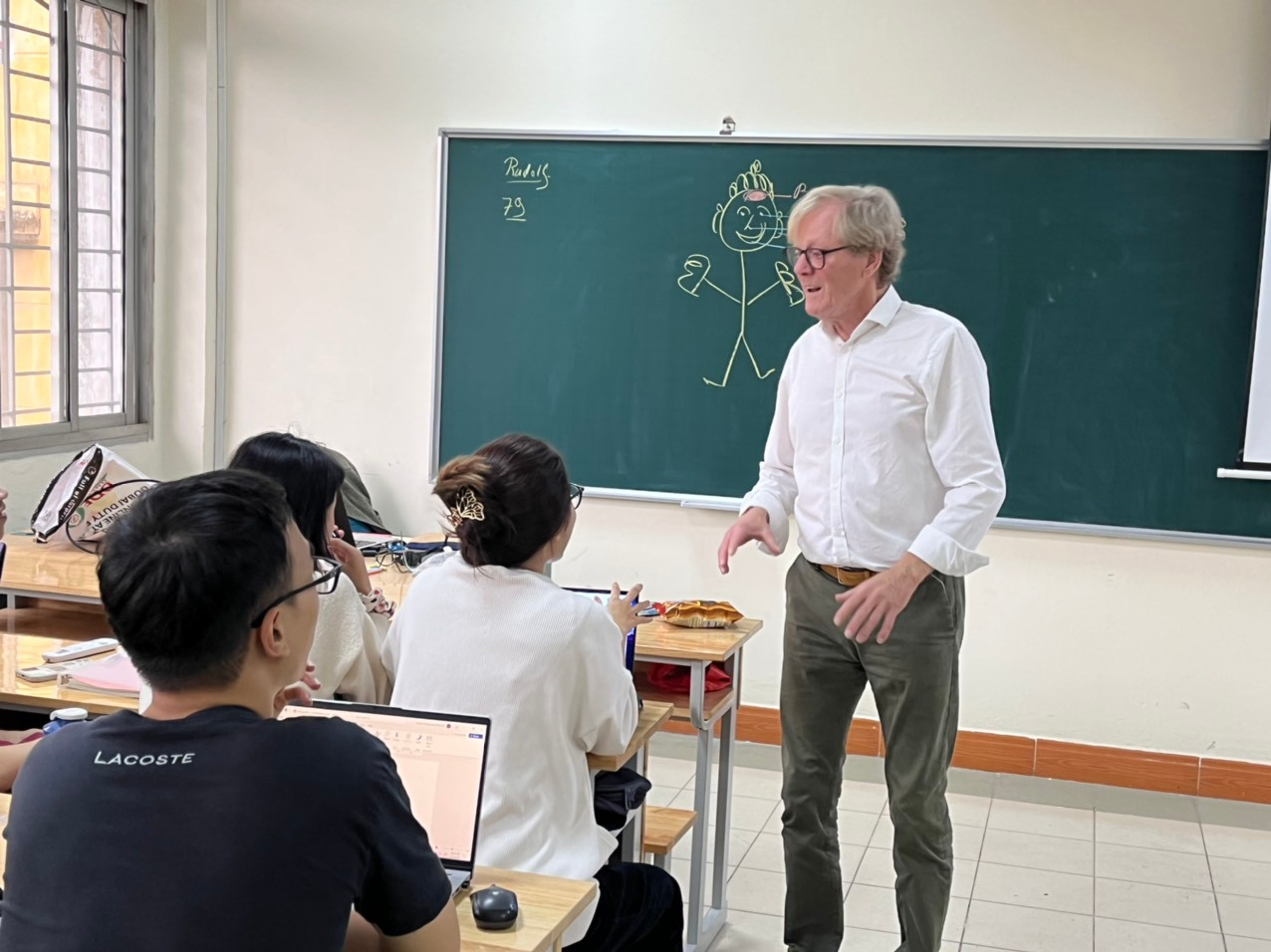
An international lecturer teaching at Hanoi University of Science and Technology.
The university’s goal is not only to teach English, but also to create an environment in which English becomes a daily academic and communication tool.
To achieve these expectations in the coming year, the university will need the collective support of its staff, lecturers, and students. Lecturers and administrative staff will gradually increase bilingual teaching and communication, moving toward a learning environment conducted primarily in English. Meanwhile, students are encouraged not only to strengthen their English-learning awareness but also to use English as a daily means of communication and actively update their specialized knowledge through international resources rather than relying solely on classroom lectures.
With a strong commitment to international integration, Hanoi University of Science and Technology expects to create a significant improvement in students’ foreign language competence, thereby contributing to the development of a high-quality workforce that meets the country’s development needs in the new era.
*Thank you very much for the conversation!
A Determined 20-Year Roadmap
The project will be implemented in three main phases: 2025-2030, 2031-2035, with a vision toward 2045, ensuring continuous, coordinated, and sustainable development. The ultimate goal is to make English the second language across all activities of Hanoi University of Science and Technology, including teaching, research, administration, and daily communication.
Phase 2025-2030: Building the foundation and expanding synchronized implementation.
Phase 2031-2035: Standardizing practices, improving quality, and ensuring long-term sustainability.
Vision toward 2045: Achieving comprehensive international integration and establishing Hanoi University of Science and Technology as a leading bilingual university in the region.

 HUST Strengthens International Academic Collaboration in...
 Hanoi University of Science and Technology Joins Alliance to...
 The First Internationally Standardized Design Factory Model...
 The Reunion of Over 2,000 Talented Students at Hanoi...
 Hanoi University of Science and Technology Graduates...
 Enterprise's Trust in Hanoi University of Science and...
 20 Petrolimex Scholarships Awarded, 20 Future Aspirations...
 Hanoi University of Science and Technology Moves Up in the...
 Hanoi University of Science and Technology and Samsung...
 Prof. Le Anh Tuan Appointed as HUST President