HUST's Message on Higher Education in the Era of Artificial Intelligence
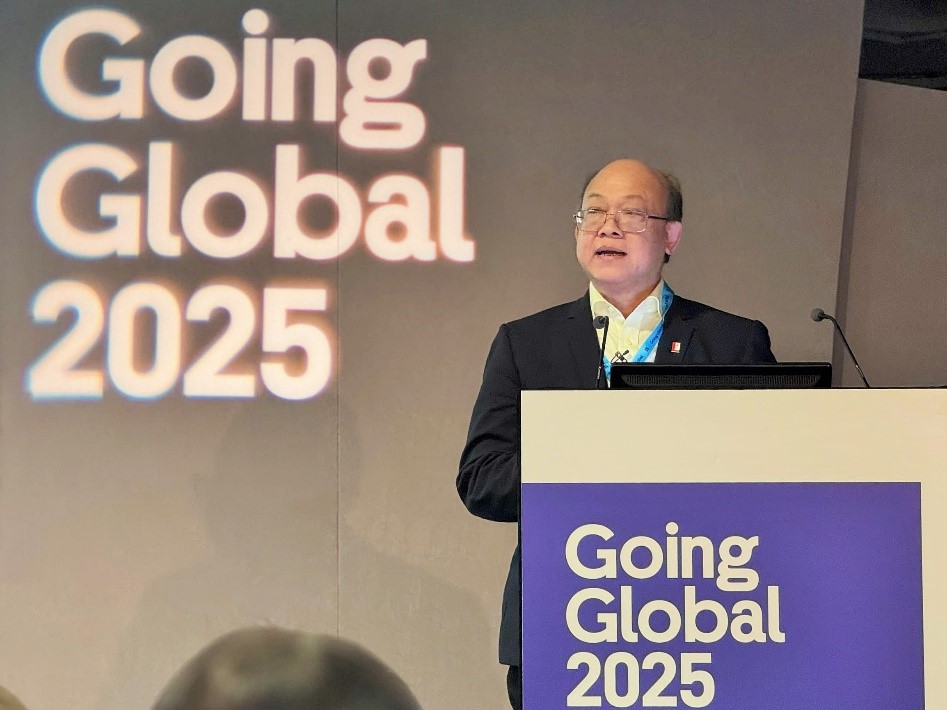
From October 28 to October 31, 2025, at the invitation of the British Council, Assoc. Prof. Huynh Quyet Thang, President of Hanoi University of Science and Technology (HUST), participated in the "Going Global 2025" conference, delivering a message and engaging in direct dialogue on the theme of Artificial Intelligence in Higher Education.
The annual "Going Global" conference is a prestigious forum for exchanging development visions and policy consultations in the education sector among nations worldwide. This year, Going Global 2025 carried the theme: “Resilience, Values, Innovation: Surviving and Thriving in a Volatile World”. The conference gathered over 350 international education leaders and experts.
As the Chairman of the UK-Vietnam Higher Education Network, Assoc. Prof. Huynh Quyet Thang was invited as a speaker for the panel discussion on "AI in Higher Education."
Making AI a Companion to Higher Education
In his opening remarks, Assoc. Prof. Huynh Quyet Thang garnered the agreement of the delegates attending the session by offering a general perspective: Higher education needs to co-develop with AI, rather than competing with or negating it. Accordingly, the period from now until the next 10–15 years is the phase to make AI a companion to higher education. To realize this vision, Assoc. Prof. Huynh Quyet Thang outlined three key points that need implementation:
First, a strong innovation in educational approaches, shifting from knowledge transmission to fostering creativity and adaptability. Creativity and adaptability are traits that technology finds difficult to replicate in humans.
Second, a strong innovation in training curricula, integrating AI into all programs—not stopping at engineering and technology majors, but also including economics, social sciences, arts, and humanities.
Third, actively fostering collaboration to form an ecosystem for continuous innovation. Only in this way can higher education adapt to the rapid changes driven by AI.
At Hanoi University of Science and Technology (HUST), this vision is reflected in a development policy based on three main pillars:
Curriculum Innovation: Integrating digital competence and Artificial Intelligence (AI) into all academic programs to equip students with adaptive and interdisciplinary skills.
Enhancing Research Quality: Promoting AI-based research and innovation activities while strengthening cooperation between academia, businesses, and state management agencies. In particular, HUST places great emphasis on the importance of the "Triple Helix" model, which involves synchronous cooperation between the State, the University, and the Enterprise.
Developing Governance Capacity: Modernizing university governance, digital infrastructure, and the academic ecosystem to support data-driven decision-making and promote lifelong learning.
Through these strategic directions, Hanoi University of Science and Technology is determined to play a pioneering role in Vietnam's digital transformation and AI development processes—not only adapting to change but actively shaping the future of higher education.
Education Compass: Ethics and Commitment to the Humanity of Technology
In his role as an experienced educator and leader of a university with a rich tradition, Assoc. Prof. Huynh Quyet Thang emphasized the message that the goal of education must always be human ethical and humanistic values.
AI technology is created by humans, accompanies human activities, and serves humans; therefore, the commitment to using technology in accordance with ethical principles is a crucial requirement of the AI application era.
This message created consensus and drew empathetic, shared understanding from education experts from many nations.
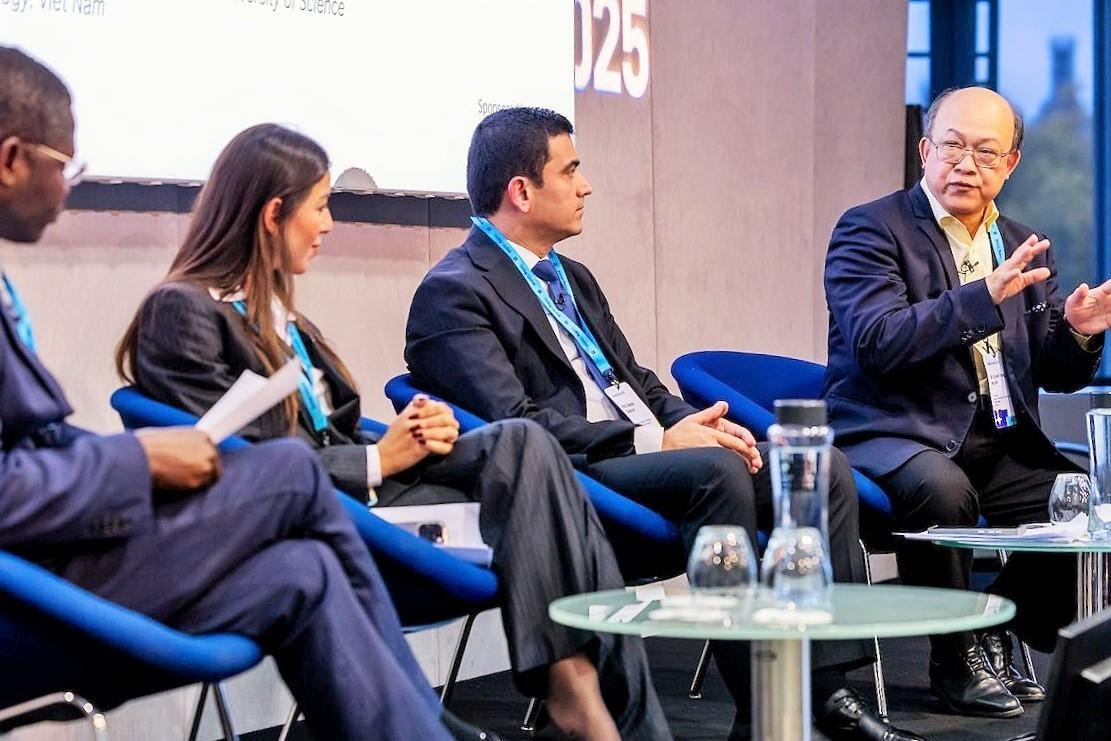
The general message and specific viewpoints raised by Assoc. Prof. Huynh Quyet Thang touched upon the key points of the topic "Artificial Intelligence in Higher Education." Consequently, many exchange questions continued to be raised, creating a lively atmosphere for the discussion session.
One question posed was: With the support of AI, can independent researchers and businesses achieve research results on their own, challenging the pioneering research role of higher education institutions?
Addressing this issue, maintaining the consistent mindset of cooperation rather than competition, Assoc. Prof. Huynh Quyet Thang pointed out the path for parties to leverage their distinct roles and strengths, joining forces to create research achievements.
Thus, through the Triple Helix model, higher education institutions are placed at the center of the innovation ecosystem: from basic research to application and commercialization, and from training to the development of technology enterprises. The roadmap is specified and the perspective made clearer thanks to Resolution 57-NQ/TW (December 22, 2024) creating leverage for science, technology, and innovation, along with Resolution No. 71-NQ/TW (August 22, 2025) creating a push for comprehensive innovation in education and training, wherein the university must become a strong research "Entity," deeply linked with businesses and the market.
With this direction, the University, the Enterprise, and the State will jointly form a research-training-application network, thereby promoting the transformation of knowledge into technology, and technology into products—contributing to Vietnam's goal of rapid, sustainable development with high income and deep international integration.
He argued that with the Triple Helix model, higher education institutions focus on basic research programs and AI-integrated research, combined with training specialized, high-level doctoral students and engaging with high-impact projects. This is the area where businesses and independent researchers do not have a strong advantage. Meanwhile, businesses contribute facilities, data, and real-world problems to orient and validate the research efforts of educational institutions. thereby creating companionship and mutual benefit.
For independent researchers, they will promote their role as an active part of the research ecosystem by adding transparency, diversity, and the ability to develop applied values.
At the same time, for the ecosystem ranging from research and application to production to operate effectively, the State has the role of creating a legal and policy environment to promote research and innovation, in which all parties can leverage their strengths.
With a systemic approach, Assoc. Prof. Huynh Quyet Thang identified common ground to connect the viewpoints of experts, businesses, and managers.
For the Success of Learners in the AI Era
Alongside research, training is always a topic of top concern. The question arises: as AI is applied increasingly widely, how do we train the people that employers will always need?
With a learner-centric message—for the success of the learner—Assoc. Prof. Huynh Quyet Thang proposed three solutions in training to help learners build a solid foundation and work confidently in the AI era.
First, develop talent training programs in AI, promote cooperation with international experts, and create clear academic pathways regarding AI. From there, learners can master AI technology to serve their work.
Second, expand practical programs suitable to market needs. While the power of AI focuses on knowledge, training programs linked with internships and real-world projects will equip students with problem-solving capabilities.
Third, train students based on labor market needs and continuously update the AI curriculum. When training programs closely follow employer needs, forming a foundation of critical thinking and appropriate skills for learners, they will stand firm in the AI technology era.
Assoc. Prof. Huynh Quyet Thang also cited HUST's efforts in expanding its partner network to help the University access and adjust its training programs to be increasingly suitable for market needs.
Vision for Developing AI Applications for Practical Projects
The discussion content moved from scientific research to training in the AI era, and then to the core issue: strategies for AI technology development in countries that are not major AI technology hubs (such as Vietnam). Assoc. Prof. Huynh Quyet Thang suggested that it is necessary to correctly recognize practical conditions to provide appropriate direction. According to him, countries with large technology ecosystems (e.g., the US, China, and some others) have the conditions to develop advanced, large-scale AI models that are popularized and verified. Countries with smaller technology ecosystems (like Vietnam) should focus on applying and utilizing these available models. The appropriate strategy for developing AI technology for higher education institutions in these countries (like Vietnam) is to focus on applying AI to projects that solve national problems, using the nation's own database and meeting national development goals.
Assoc. Prof. Huynh Quyet Thang shared his vision for AI development based on Vietnam's national database to support important sectors such as healthcare, culture, education, and environmental protection. He also cited HUST's participation in the ViGen project—an open-source Vietnamese dataset serving the development of Large Language Models (LLM) and AI in Vietnam. The University also has many projects and scientific topics addressing urgent social challenges and making meaningful contributions to the country's development.
Message on Cooperation Prospects
The discussion session was lively with positively shared viewpoints. Many global issues regarding higher education in the AI era were analyzed and exchanged frankly and profoundly. Assoc. Prof. Huynh Quyet Thang's presentation and message at the Conference received the approval of a large number of speakers and attending delegates. In particular, the positive mindset regarding the spirit of expanding cooperation was a key highlight. This not only brings solutions for sustainable development but also opens opportunities for all parties.
During this time, Assoc. Prof. Huynh Quyet Thang also attended a working session between the Vietnamese Minister of Education and Training, Mr. Nguyen Kim Son, and the UK Minister for Skills, Ms. Jacqui Smith.

As Going Global 2025 concludes, new cooperation opportunities open up.
The HUST delegation at the Going Global 2025 Conference.
Newer articles
Older articles
-
 Behind the AI Algorithms Optimizing Life-Saving Irradiation...
-
 A 30-Country Arena, a HUSTer, and the Story of Classrooms...
-
 The “Family Tradition” of HUST
-
 AI DAY 2026: Hanoi University of Science and Technology...
-
 Hanoi University of Science and Technology and The Asia...
-
 Entrepreneurship for Healing
-
 HUST Research Applies Artificial Intelligence to Medical...
-
 From the Lecture Hall to HiCamping: Study Hard, Live Fully...
-
 Hanoi University of Science and Technology Strives to...
-
 Tripartite Cooperation Integrating Training, Research, and...