Hanoi University of Science and Technology (HUST)https://www.hust.edu.vn/uploads/sys/logo-website02_136_200_1.png
Wednesday - 03/12/2025 03:25
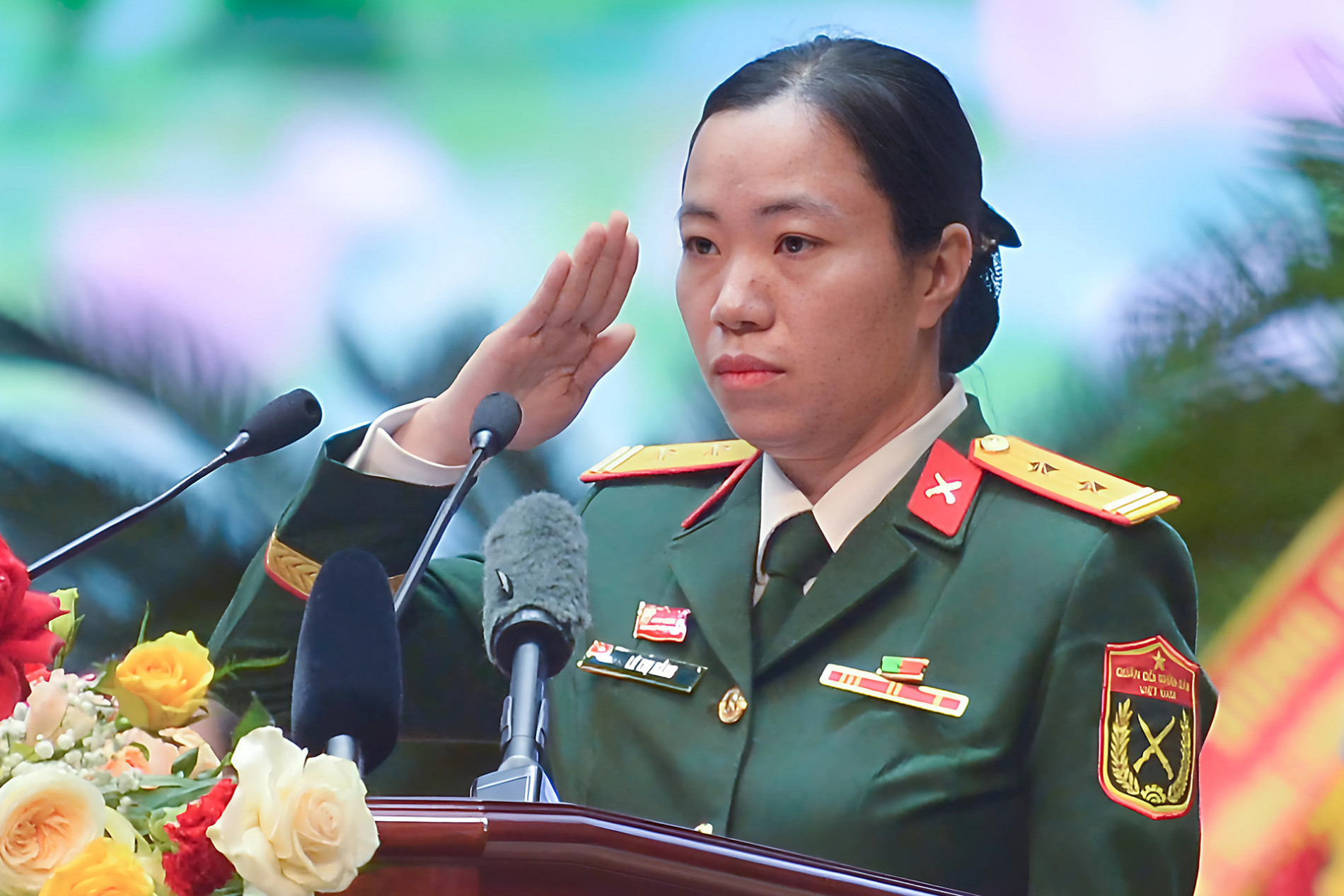
Lieutenant Colonel Le Thi Hang – Alumna of the K48 Telecommunications Engineering cohort at Hanoi University of Science and Technology, currently Director of the C4 Center, Viettel Aerospace Institute – is a prominent face of modern defense science and technology. She was awarded the title of Hero of the People's Armed Forces in the renewal period by the State President in August 2025.
Lieutenant Colonel Le Thi Hang - Alumna of the K48 Telecommunications Engineering cohort, Hanoi University of Science and Technology.
Overcoming Obstacles with Technical Passion and Independent Thinking
Lieutenant Colonel Le Thi Hang was born in 1985 in Bac Ninh. From a young age, Hang showed a special interest in natural science subjects. From late elementary school through high school, she was always a student in specialized Math classes, nurturing a growing passion for science and engineering. Despite warnings that engineering would be very hard for a girl, Hang "stubbornly" registered for the Telecommunications Engineering major at Hanoi University of Science and Technology to see just how "tough" the hardship everyone threatened really was.
Passion and independent thinking helped Hang overcome every obstacle. "I find that people only face difficulties when they don't understand the problem clearly. Learning is the same; if you study without understanding, it's very hard to remember and apply," the K48 alumna shared.
Throughout her studies, she was always proactive in asking questions and interacting with teachers, trying to understand the essence of the problem right in the classroom, especially with her habit of "not being afraid to ask." "If I didn't understand something, I would ask the teacher immediately, so during my studies, I was often the one asking the most questions in the class. I still keep this personality trait to this day," Hang recalled.
In 2007, as a final-year student at HUST, Hang interned at the Viettel Network Technologies Center. At that time, she was the only girl in the agency participating in research, manufacturing, and developing the 3G network. Admitting to having an "argumentative" and inquisitive personality, Hang recounted that her male colleagues often teased her, calling her "Mr. Hang"!
A casual photo of HUST Alumna Le Thi Hang.
During her early days on the job, almost every day she would climb poles, measure waves, calibrate equipment, write reports, and draft technical solutions until 3:00 AM, then wake up at 6:00 AM to go to work. Sometimes she worked continuously like that for six months without thinking about dresses or makeup—items typically favored by women.
In 2011, when the Viettel Research and Development Institute was established, Lieutenant Colonel Lê Thị Hang was entrusted with the task of researching and manufacturing military radar—a completely new field. After 18 months, the product executed by her and her colleagues was accepted and rated excellent. In 2016, while serving as a key officer of a center under the Viettel Research and Development Institute, she asked to return to being an engineer to participate in a special project at the Viettel Aerospace Institute.
This project required mastering a core technology in a high-tech product serving national defense, starting almost from zero.
In many developed countries around the world, radar and missiles are familiar weapons involving very high technical elements. There are not only offensive missiles but also extremely sophisticated interception systems, such as the famous "Iron Dome" missile defense system developed by Israel, the Patriot surface-to-air missile of the US, and the S300, S400, and S500 missiles of Russia. Compared to nations with solid defense science and technology foundations, Vietnam still has many limitations regarding basic science and testing/experimental systems.
"To Master Missile Technology, One Cannot Give Up"
At the All-Army Emulation Congress on September 24, Lieutenant Colonel Le Thi Hang shared the journey of researching core technology to serve the development of Vietnam's missile industry.
She stated that missile production is a top-secret field, highly specific and strictly secured, making it very difficult to access. However, if any nation can master it, it will enhance the army's strength and combat readiness.
"To master missile technology, one cannot give up; one can only do it again and do it until successful!" - Lieutenant Colonel Lê Thị Hang's statement summarized the nearly decade-long journey she and her teammates experienced—a glorious but difficult and challenging journey.
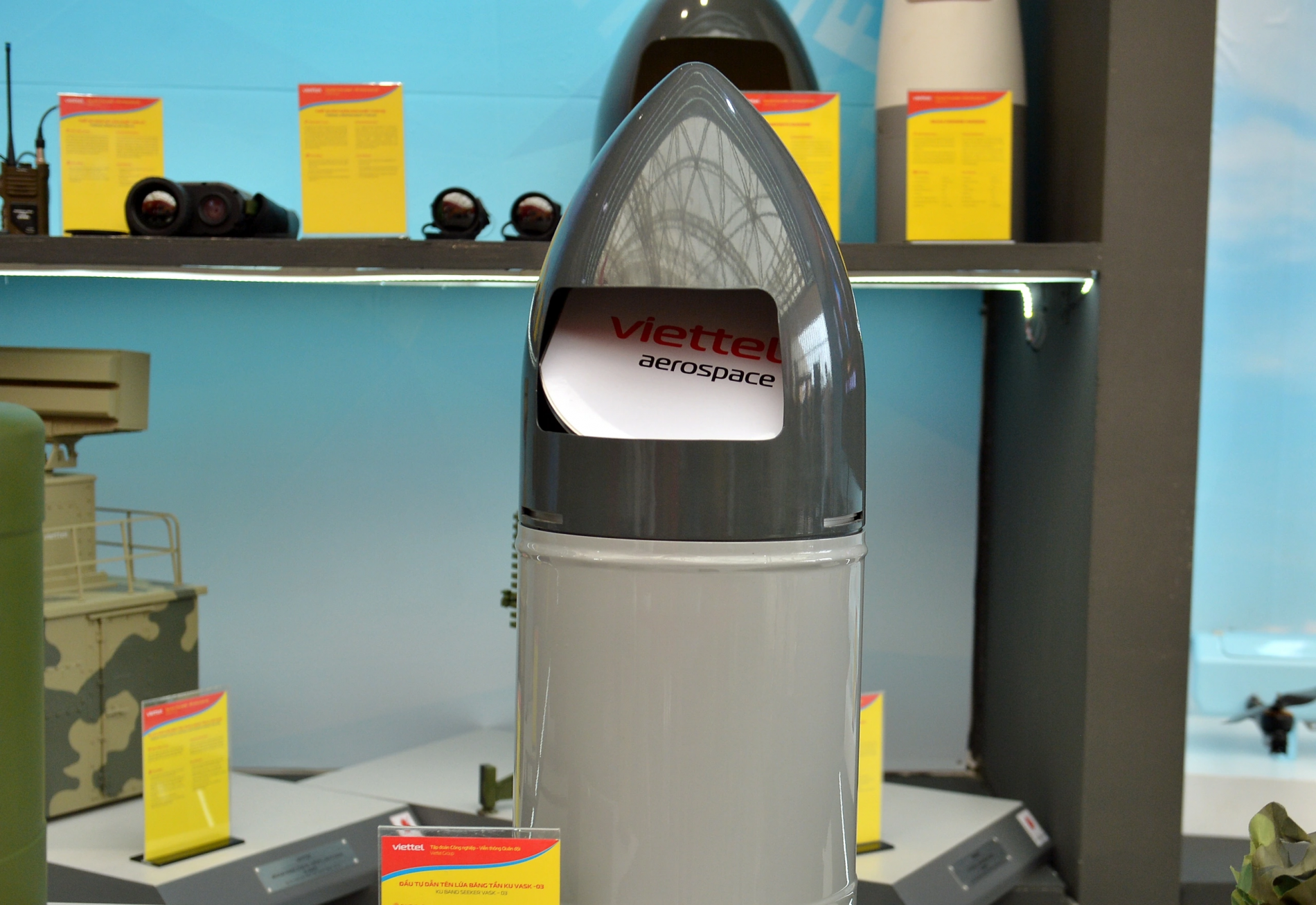
A missile structure has four parts, and the seeker/guidance head is considered the "eye," helping the missile identify, lock on, and attack the target.
The seeker can integrate active radar, semi-active radar, infrared, or laser, or even combine multiple methods. Some types are guided intermediately by GPS, INS (inertial navigation system), or via aircraft-ground data links.
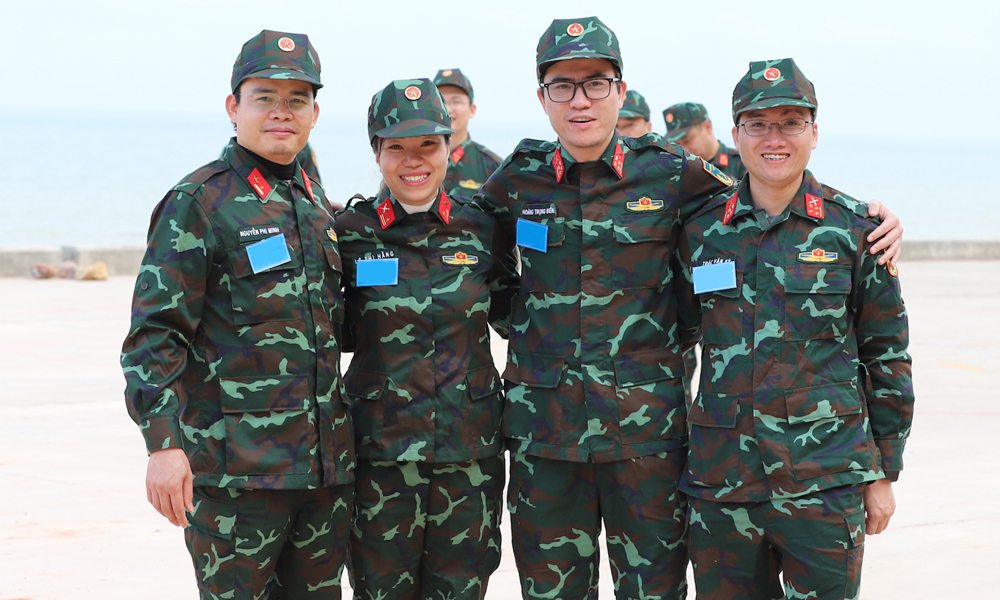
Comrade Le Thi Hang and her teammates at the product acceptance session of the Viettel Aerospace Institute.
Lieutenant Colonel Le Thi Hang recalled that when they started, none of the 7 people on the Project Board had ever worked in the missile field, and there were no complete documents, no infrastructure serving research, and foreign partners would not cooperate. Specifically, the biggest difficulty was that the engineering group had not yet defined what a "seeker head" was.
"There were times I felt like someone walking in the dark. Because the assigned field was research and trial manufacturing... there were absolutely no documents. We couldn't buy documents because if they existed, the price would be incredibly expensive, and no one would sell them anyway. Countries around the world consider this a special security field. Even when bringing a missile seeker abroad for repair, the partner's experts would 'invite' our engineers out of the room so they could work, despite having a very close relationship," Hang shared.
To overcome this challenge, Lieutenant Colonel Le Thi Hang and her teammates had to solve two major problems:
Clarify the operating principle and structure of the "seeker head."
Build a testing process that correctly reflects the missile's operating environment to verify the operation of this "seeker head."
Missile seeker head. Photo: Dinh Huy
For the first problem, Lieutenant Colonel Le Thi Hang and the engineering group applied the "reverse engineering" method, simulating combat situations, building hundreds of scenarios, and creating many trial versions to gradually perfect the guidance head.
For the second problem, the engineering group devised a breakthrough method by researching and building a test firing room themselves (this is also the first missile test firing room in Southeast Asia). Simultaneously, they used canoes and aircraft carrying the seeker head to approach the target instead of firing missiles for testing. With this creativity, they shortened the research time and saved hundreds of billions of VND for the State.
After a period of diligent work, the product researched and trial-manufactured by Lieutenant Colonel Le Thi Hang and her associates proved superior, integrating many devices, notably the phased array radar system. This system allows anti-ship missiles to fly very close to the water surface, evading detection by enemy radar from afar. The guidance system directs the missile to move to an appropriate distance, then changes altitude to enter the most favorable attack position.
The image of the simple yet resilient "rocket girl" has been inspiring thousands of young Vietnamese people in general, and HUST students in particular, to venture onto the path of scientific and technological research, continuing to write the dream of an independent, self-reliant, and modern Vietnam.

 Behind the AI Algorithms Optimizing Life-Saving Irradiation...
 A 30-Country Arena, a HUSTer, and the Story of Classrooms...
 The “Family Tradition” of HUST
 AI DAY 2026: Hanoi University of Science and Technology...
 Hanoi University of Science and Technology and The Asia...
 Entrepreneurship for Healing
 HUST Research Applies Artificial Intelligence to Medical...
 From the Lecture Hall to HiCamping: Study Hard, Live Fully...
 Hanoi University of Science and Technology Strives to...
 Tripartite Cooperation Integrating Training, Research, and...